My School Science Exhibit: Hydraulic Missile Launcher
In the world of science and engineering, ingenuity knows no bounds. As an avid enthusiast of both mechanics and DIY projects, I recently embarked on an exciting journey to create my very own hydraulic missile launcher using nothing more than simple syringes. The thrill of designing and building this innovative project was unmatched, and today, I’m thrilled to share the process and its incredible results with you.
What is hydraulics?
Hydraulics is a branch of science and engineering that deals with the mechanical properties of liquids, particularly water, and how they are utilized in various applications. It involves the study of fluid mechanics, which encompasses the behavior of fluids (liquids and gases) and the principles governing their flow.
In hydraulics, the focus is mainly on liquids, and the fundamental principles revolve around the transmission of force and energy through the use of pressurized fluids. The key components of hydraulic systems include pumps, actuators (such as hydraulic cylinders and hydraulic motors), valves, and fluid reservoirs.
Hydraulic systems are widely used in various industries and applications due to their ability to efficiently transmit power and control mechanisms.
Who invented hydraulics?
- It’s difficult to pinpoint who exactly invented hydraulics. However, the use of hydraulics-based systems can be traced all the way back to the 1st century.
- Blaise Pascal, a French physicist, mathematician, inventor, philosopher and theologian made notable achievements in the fields of hydrostatics and hydrodynamics and is credited with the invention of the first hydraulic press, which used hydraulic pressure to multiply forces.
The application of hydraulics in this project
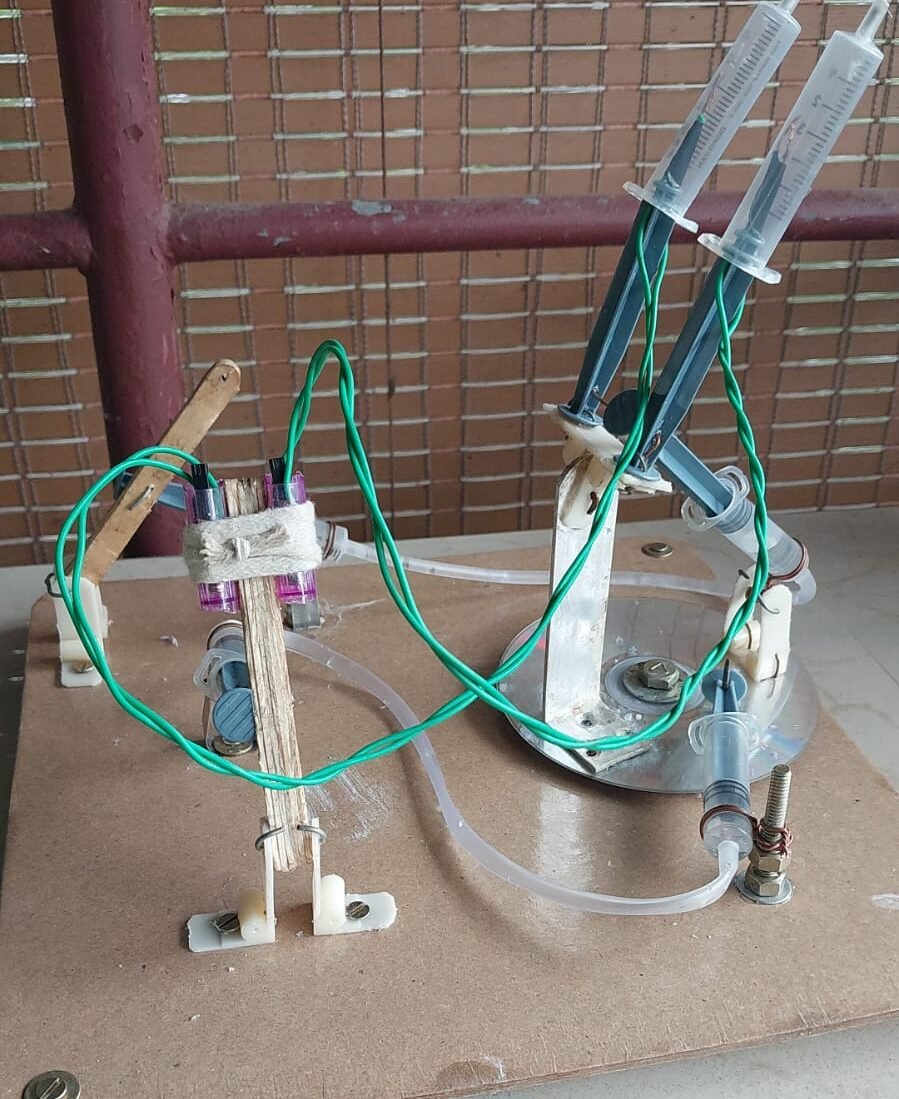
This hydraulic missile launcher is made on the basis of the mechanism of hydraulics. By utilizing the principles of hydraulics, the launcher harnesses the power of fluid pressure to launch projectiles with precision and force. The syringes serve as the key component of the system, wherein the compression of liquid within them generates a significant amount of pressure. This pressure is then used to move the direction of the launcher. The project not only demonstrates the practical application of hydraulics but also highlights the importance of fluid dynamics and engineering principles in real-world scenarios.

The Birth of an Idea:
The inspiration for this project struck me while studying the fascinating world of hydraulics. The idea of harnessing the power of fluid mechanics to launch a missile seemed both exhilarating and challenging. I decided to use syringes as the core component of my launcher, as they are readily available, easy to handle, and can generate substantial force when operated correctly.
Gather Your Supplies: To get started, I collected a few basic materials:
- Syringes (multiple)
- Plastic tubing
- Strong adhesive (epoxy or super glue)
- Wooden base
- A release mechanism (could be a trigger or lever)
- Nuts and Bolts
Building the Hydraulic System:
The hydraulic system is at the heart of our missile launcher. By utilizing the principle of fluid pressure, we can amplify the force exerted by a small input effort on the syringe plunger to launch the missile. Here’s how it works:
- Connect the syringes in a series: Take several syringes of different sizes and connect them in a line using the plastic tubing. Make sure the tubing connections are airtight by applying adhesive.
- Seal the ends: Securely seal one end of the series with adhesive to prevent any fluid leakage.
- Add the missile: Create a small airtight container for your missile, ensuring it fits snugly into the open end of the syringe system.
Assembling the Launcher: Now that our hydraulic system is ready, it’s time to build the launcher around it:
- Prepare the wooden base: This will serve as the foundation for your launcher. Make sure it’s stable and wide enough to support the syringe system.
- Mount the syringe system: Attach the series of syringes to the wooden base vertically. Ensure they are aligned correctly, with the open end facing upwards.
- Install the release mechanism: Depending on your design, integrate a trigger or lever that will apply force to the syringe plungers simultaneously. This will create pressure within the system.
The Working:
- When we connect the wooden lever with the syringe, the applied force in the syringe causes the missile to lift up.
- Same-wise, the other lever changes the direction of the launcher.
Conclusion: Building a hydraulic missile launcher using syringes was a thrilling and educational experience for me. The project taught me about fluid mechanics, pressure, and the potential power hidden within the simplest of materials. It’s important to note that while this DIY project can be enjoyable and educational, safety must always come first. Make sure to exercise caution and responsible use of such devices.
If you decide to embark on this adventure yourself, remember to have fun, explore, and always push the boundaries of your creativity. With a little knowledge and ingenuity, you too can harness the power of hydraulics to create something extraordinary!